
Last updated October 16, 2026
 Wrought iron
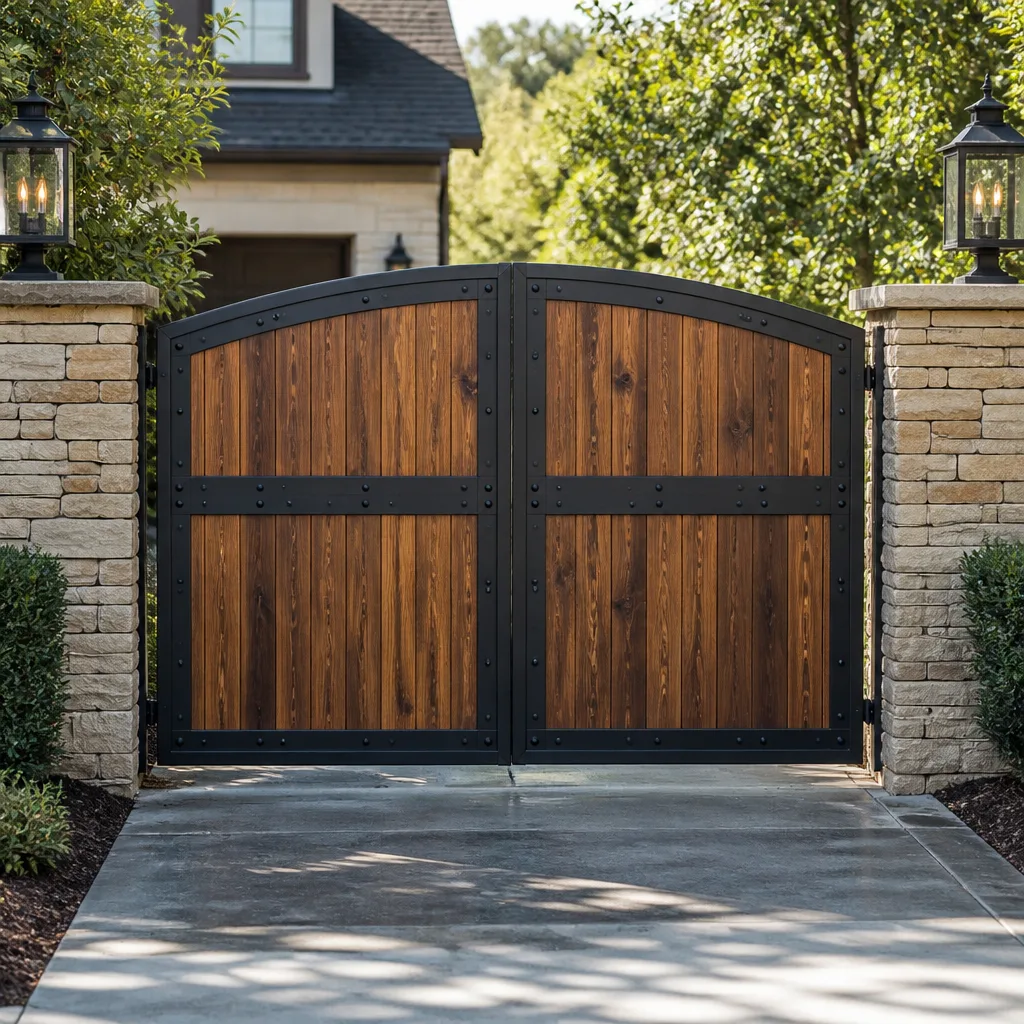 Wood & steel frame
 Farm & ranch
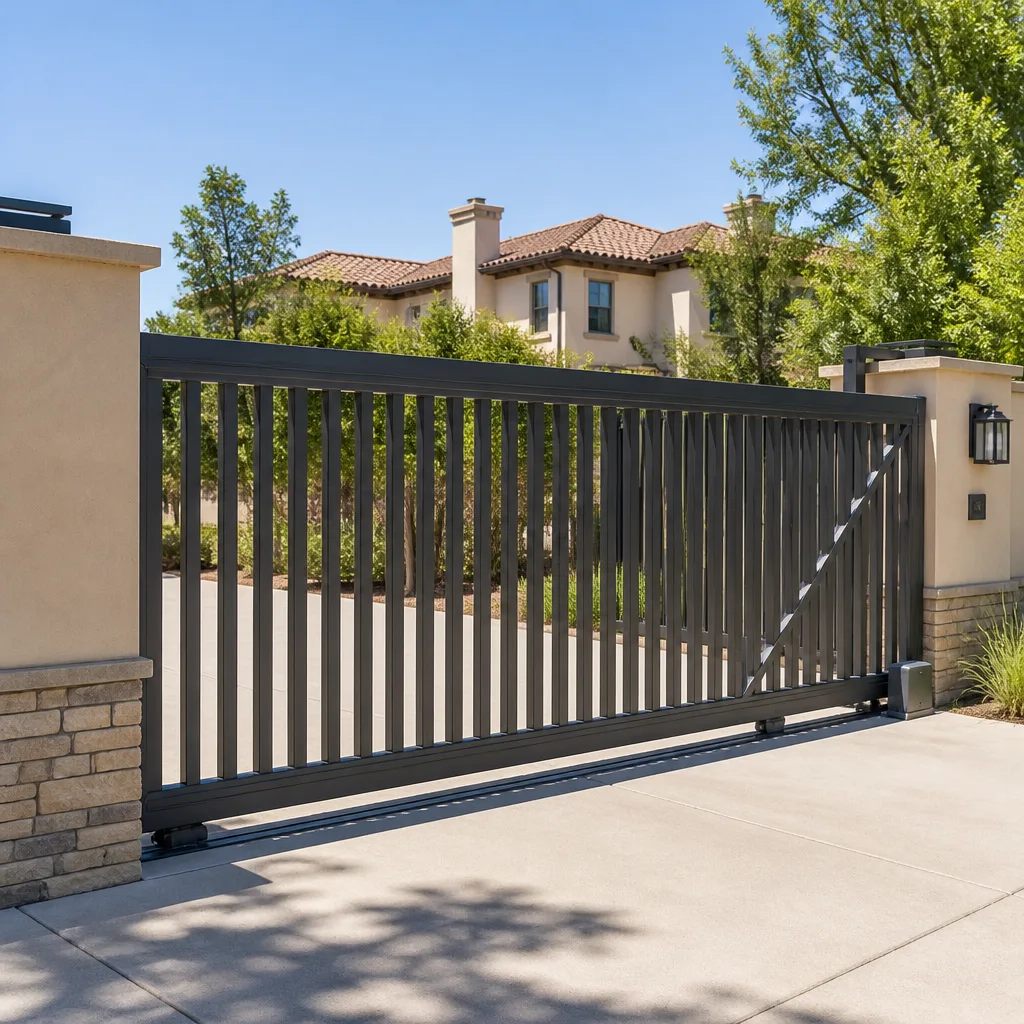 Sliding driveway gates
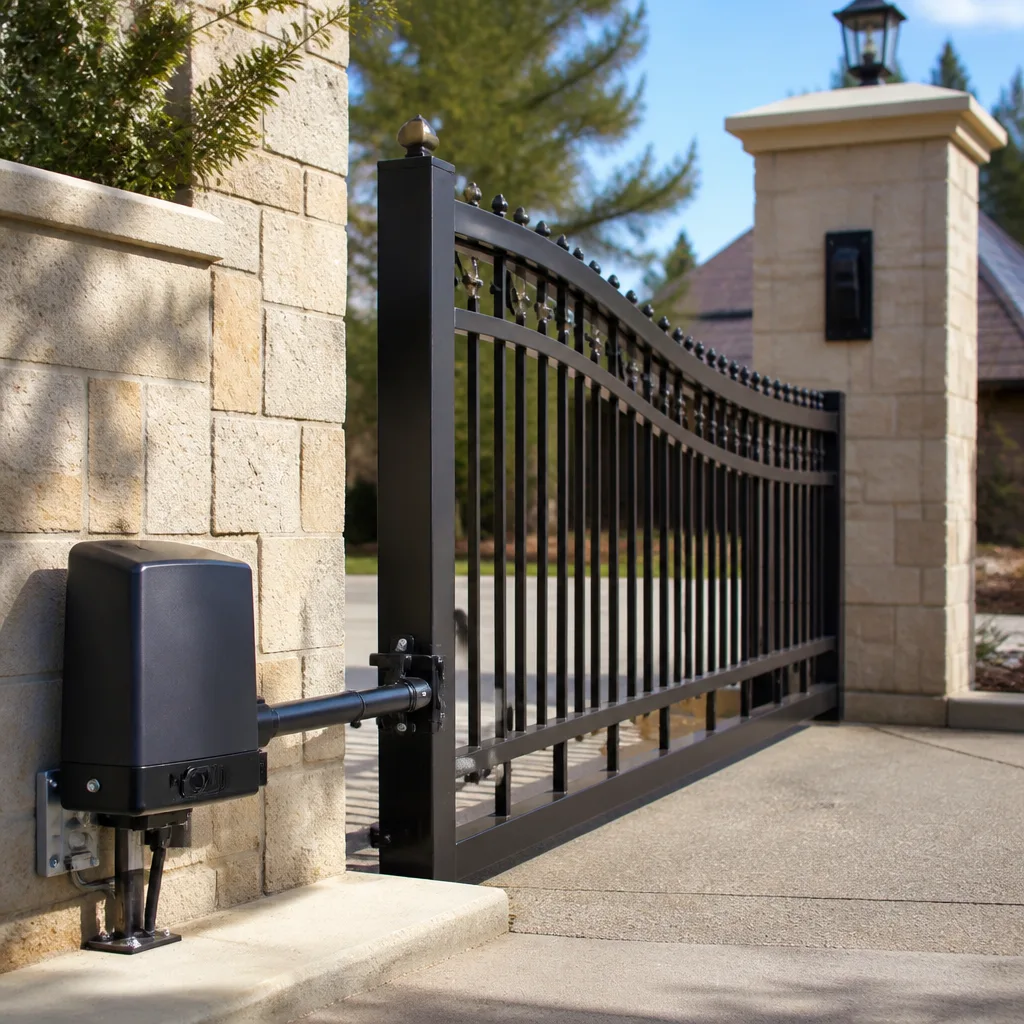 LiftMaster operators
Free on-site gate assessment - hinges, posts, and your LiftMaster or Nice gate operator checked before anything is quoted
The assessment is free and the quote is the invoice.
Get your free estimateGate Repair Warning Signs: A San Antonio Homeowner’s Reference Guide
The most expensive gate repair call we take at Warden Gate Repair San Antonio is always preceded by the same sentence: “It was doing this weird thing for a while, but I figured it would sort itself out.” It never does. The “weird thing” almost always has a specific name, a known mechanical cause, and a cheap fix if it’s caught in the first two or three weeks. Wait six months, and that $180 sensor adjustment becomes a $1,400 emergency call when the gate refuses to open on a Monday morning with your car trapped in the driveway. This guide covers the warning signs we see most often in San Antonio, what each one means, how urgent it is, and what to photograph before you call anyone for our Gate Repair services.
Quick Answer
The most common gate repair warning signs in San Antonio fall into three categories: sounds the gate makes (grinding, clicking, humming without movement), things you can see (rust at hinges, sagging, cracked welds on wrought iron), and behavior changes in automatic openers (slower travel, reversed direction, remote range under 20 feet). Any of these means the gate needs attention within two weeks at most. A gate that reverses direction on its own, a humming motor with no movement, or a visibly sagging gate leaf means stop using the gate today and call for service.
Styles & brands we work with
Table of Contents
- The Seven Sounds Your Gate Shouldn’t Make
- Visual Warning Signs on San Antonio Gates
- Automatic Opener Behavior That Signals Trouble
- Triage: Schedule Within Two Weeks vs. Stop Using the Gate Today
- How to Document Warning Signs With Your Phone
- San Antonio Climate and Soil Factors That Accelerate Gate Wear
- Common Mistakes to Avoid
- When to Call a Professional
The Seven Sounds Your Gate Shouldn’t Make
A healthy gate is nearly silent. The motor hums at a consistent pitch, the wheels roll without complaint, and the only sound is the soft click of the limit switch when the gate reaches fully open or fully closed. Any new sound is information. Here are the seven sounds we hear described most often on service calls across San Antonio, and what each one means.
1. Grinding when the gate moves
Grinding almost always means metal-on-metal contact where there should be a bearing, a wheel, or a lubricated surface. On sliding gates, the most common culprit is a failed roller bearing in one of the V-track wheels. The bearing seizes, the wheel stops turning, and the gate drags a flat spot across the track. On swing gates, grinding at the hinge usually means the hinge pin has worn through its bushing. Expect a repair cost in the $150 to $400 range if caught early. If ignored, the seized wheel will carve a groove into the track, and that track replacement pushes the job toward $900 or more.
2. Clicking that repeats every few seconds
A rapid clicking sound, especially when the gate is not moving, typically comes from the control board relay or the capacitor trying to start a motor that will not turn. In San Antonio’s summer heat, capacitor failures are more common because sustained temperatures above 95 degrees shorten their lifespan. A bad capacitor is a straightforward fix, usually under $120 including the part. A chattering relay on the control board is more serious; depending on the brand, a new board for a gate motor repair in San Antonio runs between $250 and $700.
3. Humming with no movement
You press the remote, the motor hums, and nothing moves. This is the motor getting power but failing to transfer it to the gate. On a sliding gate, the chain or belt may have jumped the sprocket, or the drive coupling between motor and gearbox has sheared. On a swing gate, the arm linkage may be binding. This is a stop-using-the-gate-now situation. Continuing to press the button will burn out the motor. A sheared coupling is a $90 to $180 fix. A burned-out motor is a $600 to $1,200 replacement.
4. Grinding that appears when the gate changes direction
If the gate moves smoothly in one direction but grinds or shudders when reversing, look at the drive chain tension and the sprocket alignment. On gates in older San Antonio neighborhoods like Alamo Heights and Terrell Hills, we often find the chain has stretched unevenly after years of thermal expansion cycles in the Texas heat. An unevenly tensioned chain loads the motor inconsistently and wears the gearbox prematurely. Adjusting chain tension is usually under $150.
5. A squeal that starts soft and gets louder
A high-pitched squeal that builds is typically a belt slipping on a pulley or a dry bearing in the motor housing. On belt-drive operators from Linear and Viking, the belt tensioner spring weakens over time, especially in garages and gate boxes that trap heat. A belt replacement is typically $120 to $250 including labor. If the squeal is from a sealed motor bearing, the repair is closer to $300, but ignoring it means a full motor replacement later.
6. A single loud pop followed by silence
If the gate makes a sharp pop and then the motor runs but the gate doesn’t move, something mechanical has broken: a chain link, a belt, a gear tooth, or a weld on the drive bracket. The pop is the sound of accumulated stress releasing. This is not a DIY diagnosis moment. Shut the power off at the breaker and call a professional. At Warden Gate Repair, we quote the price before any work starts, so you know what a broken drive bracket on a DoorKing operator costs before you commit.
7. Rhythmic thumping as the gate travels
A thump-thump-thump that matches the gate’s speed usually points to a flat spot on a wheel, a bent axle, or a warped section of track. Sliding gates in San Antonio’s newer subdivisions on the north side often sit on concrete pads that shift slightly with our clay-heavy soil. When the pad settles unevenly, the track dips, and the gate “thumps” as it rolls over the low point. Leveling the track and replacing a wheel typically runs $250 to $450.
Visual Warning Signs on San Antonio Gates
You don’t need to be a technician to read a gate. Most visual warnings are easy to spot once you know what you’re looking at. We recommend checking your gate once a month, which takes about 90 seconds, and looking for these specific signs.
Rust blooms on wrought iron
Wrought iron is beautiful and demands maintenance, especially in San Antonio’s humidity. The first sign of trouble is a “rust bloom”: a small, raised, orange-brown spot where the paint has been compromised. The bloom itself is cosmetic, but the metal underneath is thinning. At Gate Repair in San Antonio, we often find that blooms at the bottom rail, where irrigation spray hits the gate nightly, have eaten through half the metal thickness within two years. Treat a rust bloom at the base of a gate post as an early schedule-within-two-weeks item. Treat a rust bloom at a hinge or a weld as more urgent, because those are load-bearing points.
Wood grain separation on cedar gates
San Antonio heat cycles are hard on wood. Daytime temperatures above 100 degrees followed by relatively cool nights cause cedar to expand and contract repeatedly. Over a few summers, the wood develops small cracks along the grain lines, especially on the gate’s outermost board that catches the most direct sun. Hairline cracks are normal; gaps wider than 1/8 inch are not. When a gap opens, water gets in, and the board starts to cup or warp. A cupped board pulls against its neighbors, stressing the frame joinery. Replacing one or two cedar boards and resealing is typically a $200 to $350 job. Replacing the entire gate leaf because the frame twisted is often $1,200 or more.
Sagging at the hinge points
The single most diagnostic visual check on a swing gate: stand back and sight down the top edge of the gate. If the far end is visibly lower than the hinge end, the gate is sagging. Some sag is normal after ten years; more than half an inch of drop means the hinges, the post, or both are failing. On gates with a center seam where two leaves meet, sag shows up as a widening gap at the top or bottom of the seam. In San Antonio’s clay soil, gate posts shift with moisture changes. Look for a gap between the post and the surrounding concrete or soil. A post that moves when you push on it firmly needs attention fast because the gate could fall.
Cracked welds
Weld cracks start small, typically at the corners of the frame or where pickets connect to rails. They look like hairline lines with a faint rust stain. On dark wrought iron, they’re easy to miss until the gate starts to feel loose or rattle. A good monthly check includes running your eyes over every visible weld joint. A cracked weld on a decorative picket is minor. A cracked weld on a hinge plate or a structural rail is an immediate stop-use-this-gate situation. In our experience, a cracked hinge weld on a heavy iron gate is the most common precursor to a gate falling off its post entirely.
Wheel wear on sliding gates
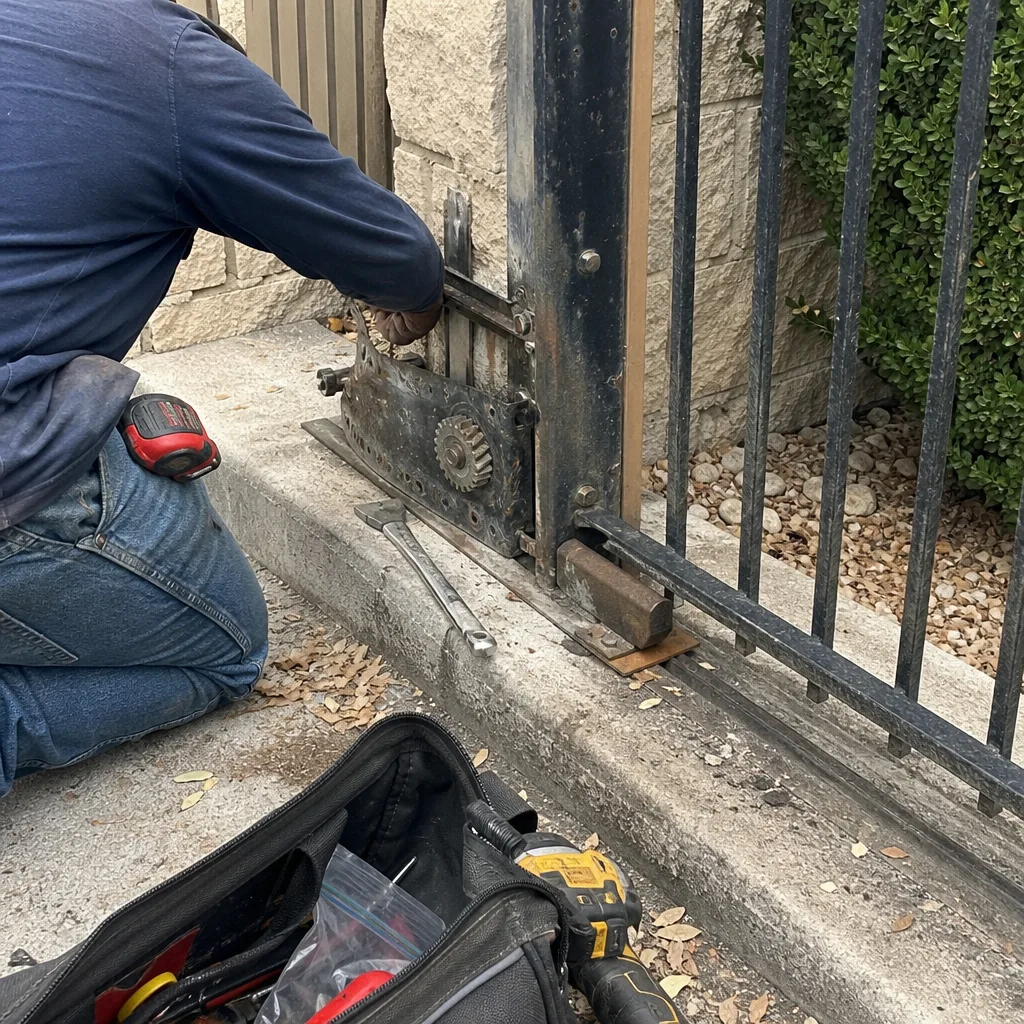
Look at the V-track wheels on a sliding gate. A healthy wheel rolls cleanly with no visible flat spots. A worn wheel has a flattened area on its circumference, often accompanied by metal shavings on the track. If you see metal shavings, the wheel is grinding against the track. That means the bearing failed, the wheel seized, and the gate is dragging. One seized wheel adds enough friction to strain the motor and shorten its life. Replacing all the wheels on a typical sliding gate in San Antonio costs between $200 and $400 and is routine work for electric gate repair in San Antonio.
Automatic Opener Behavior That Signals Trouble
Automatic gate openers have their own set of warning signs, separate from the physical gate. These are the behavioral changes we hear about most often, and what each one indicates.
The gate travels noticeably slower than it used to
Motor-driven openers are designed to move the gate at a consistent speed. If your gate that used to open in 12 seconds now takes 20, something is adding load. Common causes in San Antonio include: the gate’s wheels have worn and added friction, the track has accumulated debris from the gravel or decomposed granite common in Hill Country landscaping, or the motor itself is losing power. A slower gate is a warning sign you should not ignore, because the added load shortens motor life quickly. Expect a diagnosis call to cost between $75 and $150, with the fix typically running $150 to $450 depending on the cause.
The gate reverses direction without touching anything
Most automatic gates are equipped with an obstruction detection system. If the gate starts closing, then reverses as if it hit something, but nothing is there, the obstruction sensor is either misaligned, dirty, or failing. In San Antonio’s dust and pollen seasons, sensors on gates in heavily landscaped areas get coated quickly. Cleaning and realigning a sensor is usually under $100. But if the sensor tests fine, the issue may be in the control board, which pushes the cost higher. Treat unexplained reversals as an urgent safety issue, because a failing obstruction sensor can also fail to detect an actual obstruction, like a child or a pet in the gate’s path.
Remote range has dropped below 20 feet
If your remote used to open the gate from the end of the street and now only works within 20 feet, one of three things is happening. The remote battery is dying (cheapest fix, under $10). The receiver antenna on the control board has been damaged or corroded (typically a $75 to $150 fix). Or, there’s new radio frequency interference from nearby electronics, which is increasingly common in San Antonio neighborhoods with dense Wi-Fi environments. Rule out the battery first. If the range doesn’t recover, have the receiver checked. This is a Ghost Controls and DoorKing issue we address regularly; both brands have receivers that are sensitive to antenna positioning.
The gate stops partway and requires a second button press
If the gate stops at the same spot every time and needs another press to continue, the limit switch is misreading the gate’s position. Limit switches tell the motor where the gate is. When they slide out of adjustment, the motor thinks the gate has reached its full travel when it hasn’t. This is more common on gates that have been bumped, or on installations where the original limit positions were set in cooler weather and have shifted as metal expanded in summer heat. Limit switch adjustment on a Linear or Viking operator is typically a $100 to $175 service call in San Antonio.
Photo-eye or safety edge behaving erratically
Gates with safety edges on the leading edge, or photo-eye sensors mounted on the posts, are designed to stop the gate when something breaks the beam or touches the edge. If your safety system activates randomly, with no one near the gate, there’s a wiring issue, a failing sensor, or moisture in the connection. San Antonio’s summer thunderstorms and high humidity make corrosion in low-mounted connections a common culprit. If the safety system doesn’t respond when you wave your hand in front of the sensor, stop using the gate immediately. A non-functioning safety system on an automatic gate is a serious hazard. Repairs typically run $100 to $250 for a sensor or edge replacement.
Triage: Schedule Within Two Weeks vs. Stop Using the Gate Today
Not every warning sign is an emergency. Here’s our triage framework, based on what we’ve seen across thousands of service calls in San Antonio. Use this to decide how quickly you need to act.
Stop using the gate today
- Gate reverses direction on its own: The obstruction detection system is unreliable, which means the gate may close on a person, pet, or vehicle.
- Motor hums but the gate doesn’t move: Continuing to press the button will burn out the motor. Shut off the circuit breaker.
- Cracked weld on a hinge or structural rail: The gate could fall. This is not something to gamble with, especially on heavy iron gates.
- Safety edge or photo-eye fails the wave test: If the gate doesn’t stop when you interrupt the beam or press the edge, the safety system is dead.
- Gate post moves when pushed: A shifting post means the gate’s foundation is failing. The gate could drop.
Schedule within two weeks
- New grinding or squealing sound: It will get louder and more expensive, but it’s unlikely to fail catastrophically in the next few days.
- Gate traveling slower than normal: Added friction is wearing the motor, but the gate still functions.
- Rust blooms at non-structural points: Cosmetic now, structural later. Two weeks of delay won’t matter much.
- Wood grain separation under 1/8 inch: Schedule sealing before the first big rain to prevent the boards from cupping.
- Remote range under 20 feet with a fresh battery: Annoying, possible receiver issue, but not dangerous.
How to Document Warning Signs With Your Phone
Before you call anyone, spend five minutes documenting what you’re seeing and hearing. A well-documented gate problem saves a technician time, which saves you money, and it gives you a record if there’s ever a dispute about what was done. Here’s what to capture.
Step 1: Photograph the gate from three angles
- Full gate, straight on: Stand about 15 feet back and photograph the entire gate, showing how it sits in the frame.
- Full gate, side view: Stand to the side and photograph along the gate’s length to show any sag or alignment issues.
- Close-up of the problem area: If you see a rust bloom, a cracked weld, a worn wheel, or a gap in the wood, get within a foot and take a sharp photo. Include something for scale, like a coin or your finger.
Step 2: Record a 15-second video with sound
Use your phone to record the gate opening and closing while you hold the remote. Walk alongside the gate if it’s a slider so the video captures the wheels and track. The sound is as important as the picture. A technician who hears a grinding noise before arriving can often bring the right parts on the first visit, instead of scheduling a second trip.
Step 3: Take a photo of the operator and its label
Find the operator: the box that houses the motor and control board. Photograph the label that shows the make and model. Brands like Linear, Viking, Ghost Controls, and DoorKing all have model numbers that tell a technician exactly what parts they’re working with. This is specific information that saves time and money.
Step 4: Note the conditions when the problem occurs
Write down when the gate misbehaves. Does it only happen in the morning? After rain? When it’s been sitting in direct sun? San Antonio’s temperature swings and afternoon thunderstorms can turn an intermittent electrical issue into a pattern. A note like “the gate reverses on its own after it rains” points a technician toward moisture in the connections, which is a different fix than a misaligned sensor.
At Warden Gate Repair, we use your photos and video during the initial phone call to give you an accurate price range before we ever send someone out. The more you document, the more precise that range becomes.
San Antonio Climate and Soil Factors That Accelerate Gate Wear
Gates in San Antonio don’t wear the same way gates in Dallas or Houston do. Our specific climate and soil create specific failure patterns. Understanding these helps you spot problems earlier.
Clay soil and post shifting
Most of San Antonio sits on expansive clay soil. Clay absorbs water and swells during wet periods, then shrinks and cracks during dry spells. This constant movement puts pressure on gate posts, especially posts set in concrete footings that are too shallow. We see post shifting most often in neighborhoods built on the blackland prairie clay, including areas on the east side and along the Medina River basin. A gate that worked perfectly for years may suddenly bind or sag after a wet spring, and the cause is the ground moving under it, not the gate itself.
Heat and capacitor failure
San Antonio averages over 100 days above 90 degrees per year. Extreme heat accelerates the failure of electronic components, especially capacitors in gate operator motors and control boards. A capacitor that might last 10 years in a mild climate can fail in 5 or 6 years here. If your gate won’t start on the first try on a hot afternoon but works fine in the morning, suspect the capacitor. It’s a common San Antonio-specific failure that costs under $120 to fix.
Humidity and corrosion
San Antonio’s relative humidity averages around 67 percent year-round, and summer thunderstorms spike it higher. For gate electronics, humidity means condensation inside control boxes, corrosion on electrical connections, and accelerated rust on unprotected steel. Gates that face east and catch morning sun while still wet from overnight condensation tend to show rust first. If your gate is within half a mile of the San Antonio River or any of the creeks, expect faster rust development on steel and iron components.
Oak pollen and debris
Live oaks are everywhere in San Antonio, and their pollen and leaf litter get into everything, including gate tracks and photoelectric sensors. In March and April, when oak pollen is at its heaviest, we see a spike in service calls for gates that stop mid-travel because the track is fouled or the safety sensor is coated. A springtime track cleaning is cheap insurance; it’s usually a $75 to $125 service.
Common Mistakes to Avoid
- Waiting for total failure: This is the big one. A grinding noise is a $150 fix today and a $900 fix in six months. Gates do not heal. The problem only gets worse, and the repair bill grows with it.
- Lubricating without cleaning first: Spraying grease over a dirty track or hinge traps grit and accelerates wear. Clean the surface first, then apply the right lubricant sparingly. Better yet, let a professional handle the lubrication during a service visit, because the wrong grease on certain bearings causes swelling of the seals.
- Adjusting the opener force limit upward to “fix” a slow gate: If the gate is dragging and you crank up the motor force, you’re masking the symptom and burning out the motor. The force limit exists for safety; increasing it also makes the gate more dangerous if it hits something.
- Ignoring a sagging gate because it still works: A sagging gate is a falling gate in slow motion. The stress is concentrated at the hinge or the post, and when it finally goes, it goes all at once.
- Hiring the first person who answers the phone without asking who’s coming: This is the mistake we built our company around. Know the name of the technician, know that they’ve been background-checked, and know the price before they arrive. If a company won’t tell you who’s coming to your door, pick another company.
- Skipping the monthly visual check because “nothing seems wrong”: Warning signs start small. A monthly 90-second check catches them when the fix is cheap. Set a calendar reminder.
When to Call a Professional
If your gate is making any of the seven sounds described above, if it’s sagging, if the safety system isn’t responding, or if the opener is behaving erratically, you’re past the point of observation and into the point of action. Some things are genuinely safe to handle yourself, like changing a remote battery or clearing loose debris from a visible track. But gate springs, hinges under load, motor capacitors, and safety systems are not DIY territory. A gate that weighs several hundred pounds carries enough energy to cause serious injury if a spring lets go or a weld fails while you’re working on it. If you’re unsure, call. Warden Gate Repair San Antonio offers free estimates in San Antonio, and we tell you the price before any work starts, so call (940) 531-3336 and you’ll get a clear answer, not a sales pitch.
See the difference
 Before
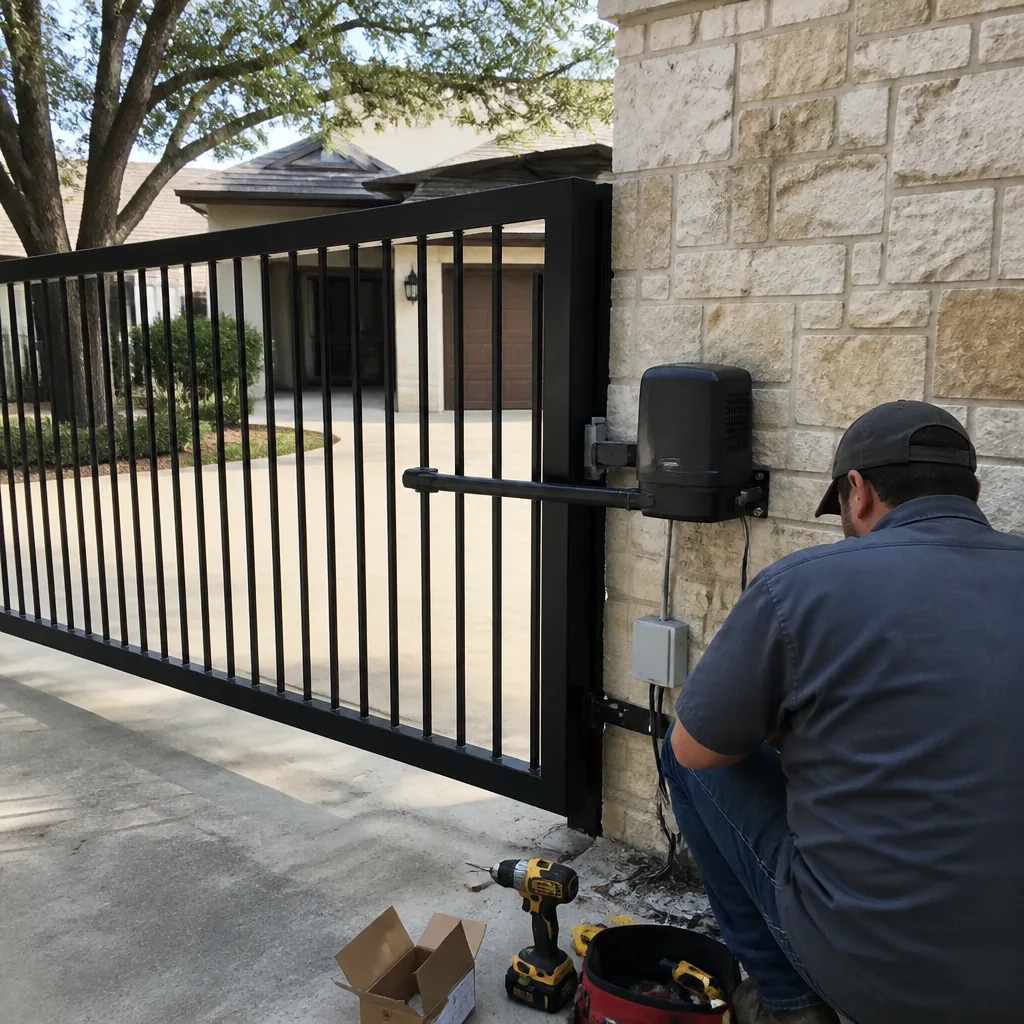 After
After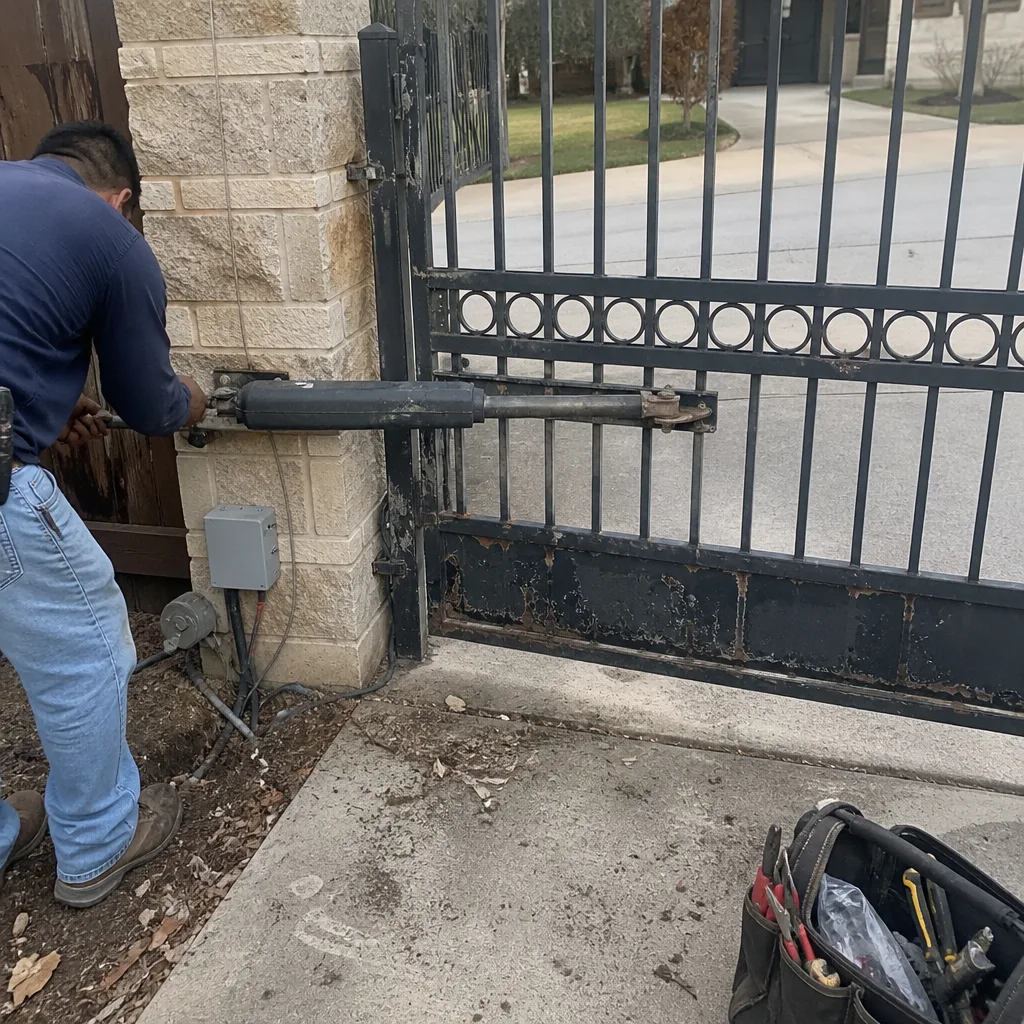 Before
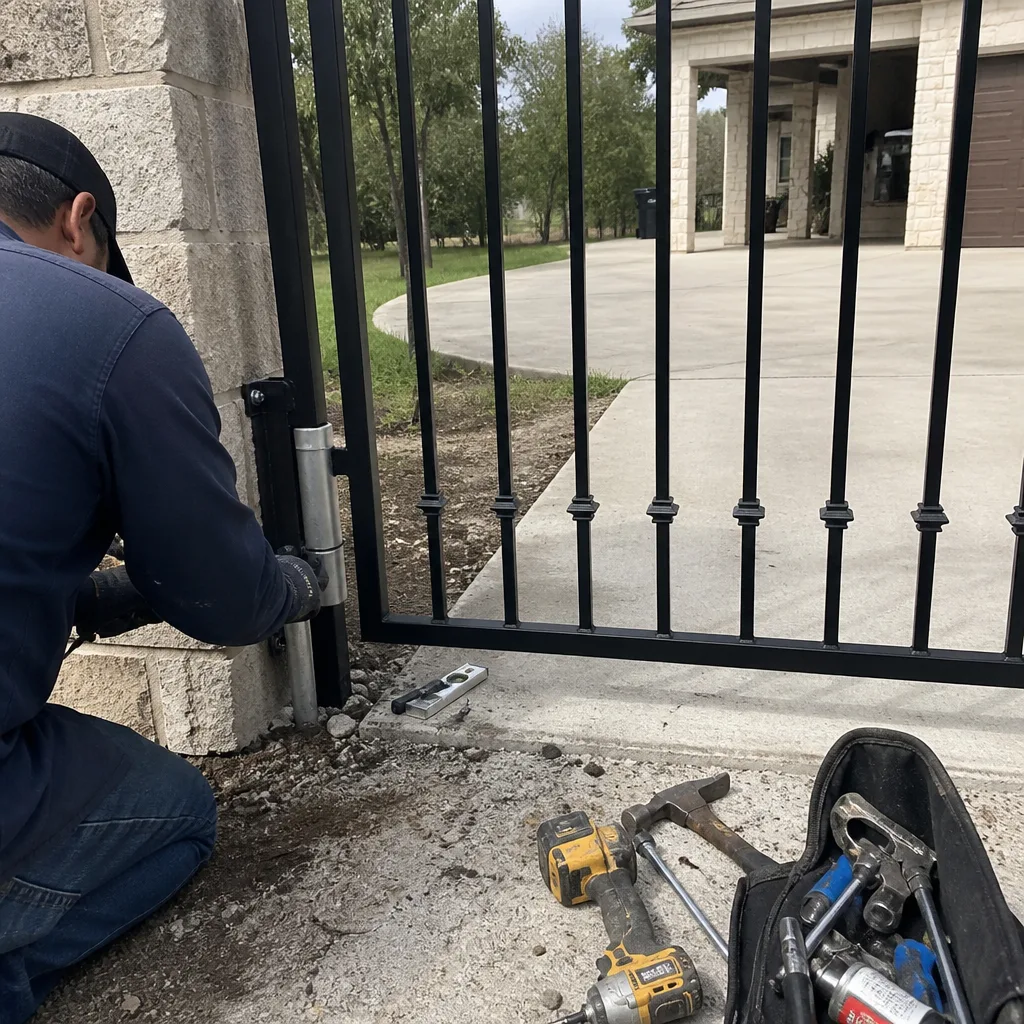 After
After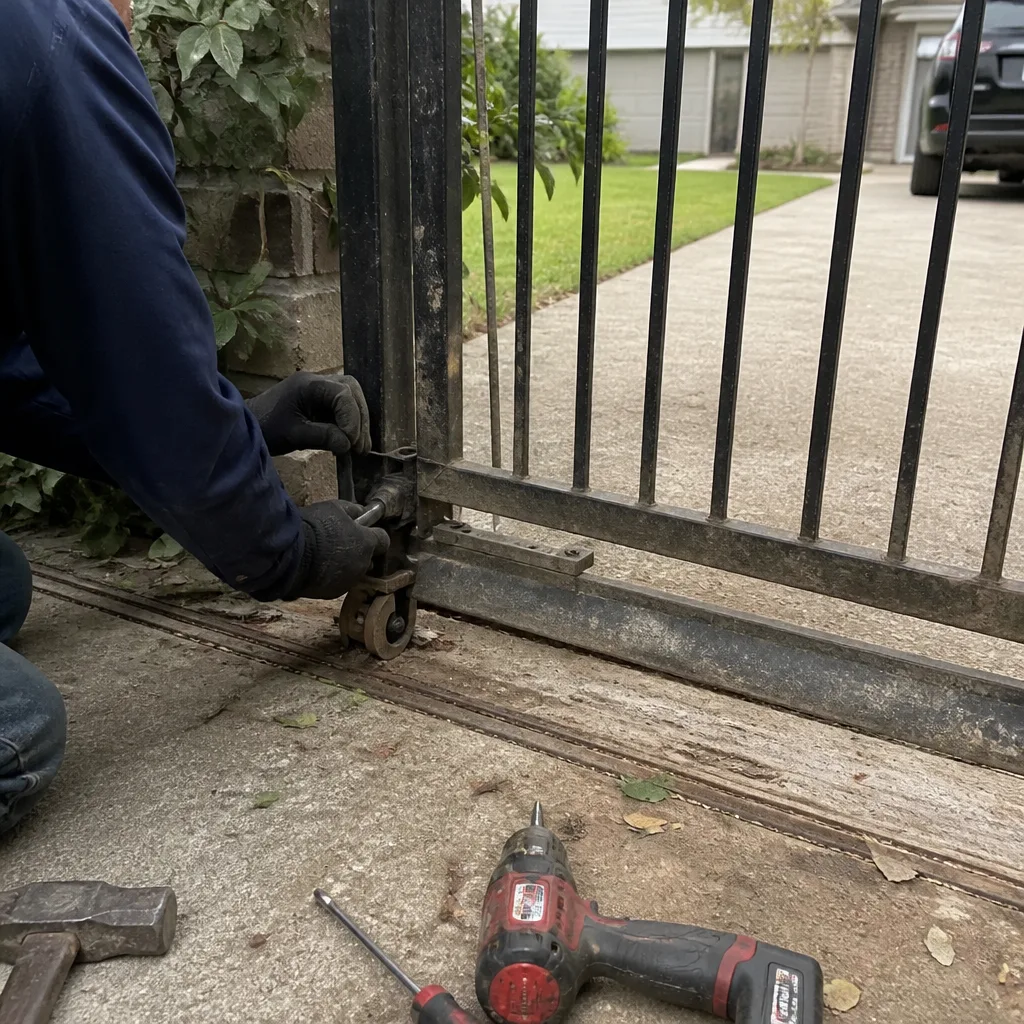 Before
 After
AfterFrequently Asked Questions
The most common warning sign we see in San Antonio is a grinding noise when the gate moves, which almost always traces to a failed wheel bearing on a sliding gate or a worn hinge bushing on a swing gate. A grinding gate is typically a $150 to $400 repair if caught within the first few weeks. Call (940) 531-3336 for a free estimate and we’ll tell you what the noise means before you commit to anything.
Most gate repairs in San Antonio fall between $150 and $450, with the specific price depending on the component that failed. Sensor and limit switch adjustments typically run $100 to $200, wheel and bearing replacements $200 to $400, and motor replacements $600 to $1,200. At Warden Gate Repair, the price is always quoted in writing before any work starts, so there are no surprises when the invoice arrives.
A clicking sound with no movement usually means the capacitor is failing or the control board relay is chattering, both of which are common in San Antonio’s summer heat. The capacitor is a cheap fix, typically under $120. A chattering relay may mean a control board replacement, which runs $250 to $700 depending on the brand. Stop pressing the button and call us; continuing to cycle the opener can burn out the motor.
Yes, Warden Gate Repair San Antonio maintains live phone coverage 24 hours a day and can often dispatch a technician the same day for emergency gate issues, including gates that won’t open or close. Every technician is background-checked, identity-verified, and sent to you by name and photo before arrival. Call (940) 531-3336 and we’ll tell you right away whether same-day service is available for your specific problem.
If a gate opens normally but struggles to close, the problem is usually resistance in the closing direction, which points to a track alignment issue, a worn wheel, or a misadjusted limit switch. On swing gates, it can also mean the closer-side hinge is binding. The fix typically runs $150 to $350. We document the exact issue with photos and give you a written price before any work begins.
Yes. A gate that reverses direction without an obstruction means the safety system is unreliable, which creates a real hazard for people, pets, and vehicles. Treat this as a stop-using-the-gate-today situation. Shut the gate off at the breaker and call us at (940) 531-3336; we’ll send a background-checked technician with a photo and name before arrival so you know exactly who’s coming to your door.
The Bottom Line
A gate talks before it fails. Grinding bearings, slowing travel, rust blooms, sagging hinges, and quirky opener behavior are all early warnings. In San Antonio’s heat, humidity, and shifting clay soil, those warnings come earlier and progress faster than they do in milder climates. The difference between a $180 fix and a $1,400 emergency is usually about six weeks of attention. Check your gate monthly, document what you find, and call a professional the moment you see or hear something unusual, or explore more guides & resources to stay informed. Warden Gate Repair San Antonio gives you a written price before any work starts and a name and photo of your technician before they arrive. That’s how gate repair should work.
Written by Cole Rafferty, Owner at Warden Gate Repair San Antonio, serving San Antonio since 2008.