
Last updated October 16, 2026
 Wrought iron
 Wood & steel frame
 Farm & ranch
 Sliding driveway gates
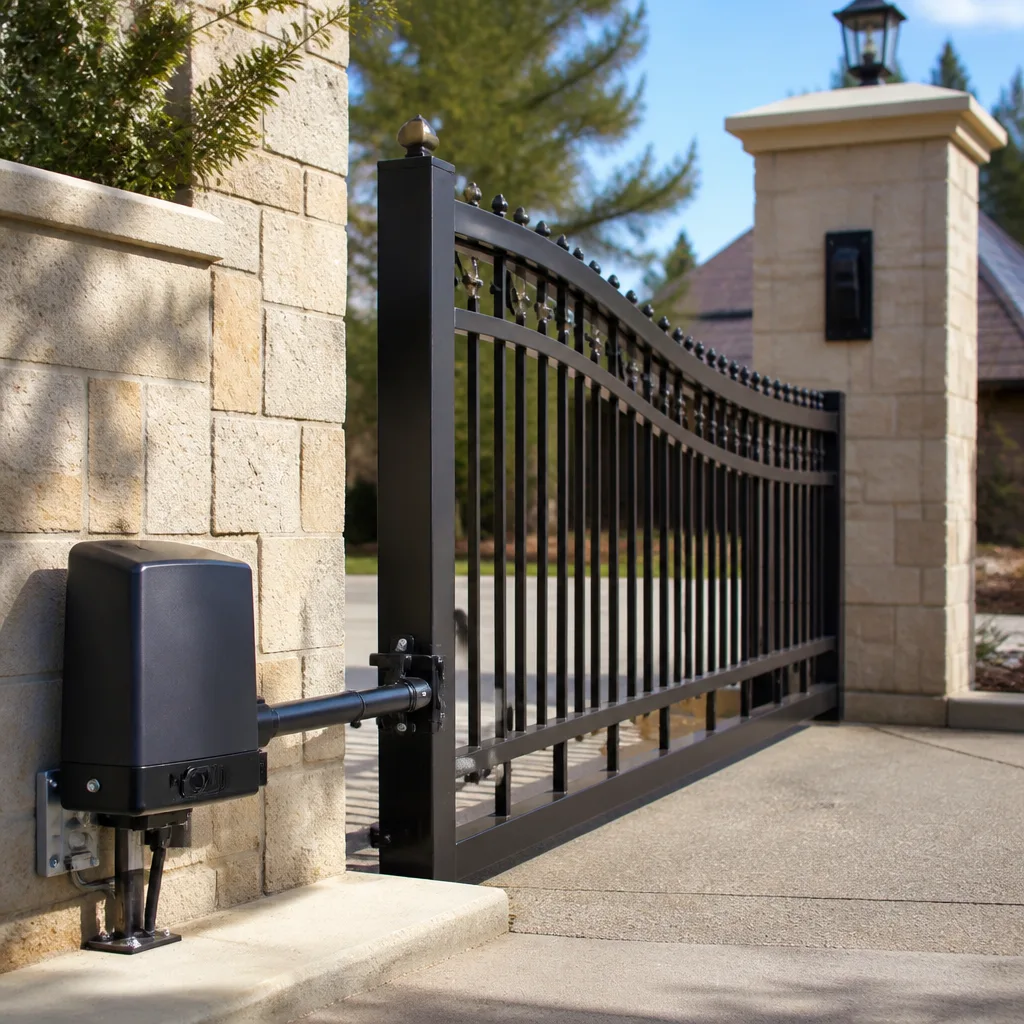 LiftMaster operators
Free on-site gate assessment - hinges, posts, and your LiftMaster or Nice gate operator checked before anything is quoted
The assessment is free and the quote is the invoice.
Get your free estimateSeasonal Gate Repair Care for San Antonio: Year-Round Homeowner’s Guide
February in San Antonio is a strange month. The mountain cedar is dumping pollen across Bexar County while the forecast keeps flirting with freezing temperatures. That odd pairing is exactly why “spring maintenance” checklists written for Dallas or Houston miss the point here. Cedar pollen gums up photo-eye sensors, and a hard freeze stresses hydraulic fluid and battery backups at the same time. This guide builds a seasonal calendar around what actually happens in San Antonio weather, month by month, so you can protect an automatic gate that cost thousands to install and hundreds to repair when neglected.
Styles & brands we work with
Quick Answer
Seasonal gate care in San Antonio means doing four specific jobs at four specific times of year: a cedar-pollen sensor cleaning and pre-freeze check in January – February, a heat-prep lubrication and gear inspection in May, a drainage and post-grade check before the October – November rain window, and a full operator exercise and limit-switch test before the first winter freeze. Most of this takes under 30 minutes per season, and skipping it is the single most common reason we replace gate motors that should have lasted another five years.
Table of Contents
- Why San Antonio Weather Treats Your Gate Differently Than Dallas or Houston
- Winter Freeze Prep (January – February): Hydraulic Fluid, Batteries, and the 10-Minute Pre-Freeze Check
- Cedar Season Sensor Care (December – February): The Overlooked Task That Prevents Phantom Stops
- Summer Heat Survival (June – September): Grease Breakdown, Gear Wear, and the Real Re-Lubrication Interval
- Fall Storm Prep (October – November): Drainage Slopes, Post Grades, and Flood-Proofing Your Track
- The One-Page Seasonal Summary: Photograph This and Keep It in a Utility Drawer
- Common Mistakes to Avoid
- When to Call a Professional
- Frequently Asked Questions
- The Bottom Line
Why San Antonio Weather Treats Your Gate Differently Than Dallas or Houston
San Antonio sits on the edge of two climate zones. We get the Hill Country’s dry heat and flash-flood drainage patterns to the northwest, plus the Gulf humidity and cedar pollen to the southeast. That mix means no single national maintenance schedule fits. Dallas gates freeze harder but dry out faster. Houston gates fight rust and humidity year-round but rarely see a hard freeze. San Antonio gates get both, often in the same month. If you have an electric gate on a home in Alamo Heights, Stone Oak, or Helotes, you’re managing limestone dust, cedar pollen, triple-digit pavement heat, and the occasional ice storm. Our repair calls follow the same pattern every year, and we’ve built this guide around that pattern rather than around a generic four-season calendar.
If you’re new to gate ownership or just bought a home with a gate, check our Gate Repair in San Antonio guide first. It covers the basic anatomy of a swing and slide gate so this seasonal guide makes more sense.
Winter Freeze Prep (January – February): Hydraulic Fluid, Batteries, and the 10-Minute Pre-Freeze Check
The most likely month for a hard freeze in San Antonio is February. We saw it in 2021 with Winter Storm Uri, and even average years bring at least one night below 28°F. Freezing temperatures do two specific things to a gate system: they thicken hydraulic fluid in FAAC and BFT hydraulic operators, and they cut the effective capacity of the 12-volt backup batteries that keep your gate working when the power drops. A hydraulic operator with cold, thickened fluid moves slower and pulls more amps. The added amp draw can trip a breaker mid-cycle, leaving your gate open or closed at the worst possible time.
Here is the 10-minute pre-freeze check we recommend every January:
- Check the operator housing for moisture. Open the cover of your gate operator (the box that slides or swings your gate automatically) and look for condensation, standing water, or white corrosion on terminals. Water inside a housing freezes and expands, which cracks seals and shorts boards.
- Test the battery backup. If your operator has a battery backup (most Linear and Viking units do, plus many LiftMaster models), unplug the operator from AC power and run the gate one full open-close cycle. If it moves slower than normal or stops mid-cycle, the battery is weak and should be replaced before a freeze event, not after.
- Inspect the hydraulic fluid level on FAAC or BFT hydraulic swing operators. Look for the sight glass or dipstick. Low fluid plus cold temperatures is a recipe for a stalled gate.
- Run the gate through a full cycle. Stand where you can see both ends of the travel path. Listen for grinding, hesitating, or a change in motor pitch. A gate that struggles in 55°F weather will fail in 25°F weather.
- Clear debris from the track or hinge area. Leaves, gravel, and dirt hold moisture. That moisture freezes and blocks movement, which makes the operator work harder and trip safety sensors.
One more thing about freezes in San Antonio: the temperature swings fast. A gate that works fine at 5 p.m. can bind up at 3 a.m. when the cold front rolls through. If your gate ever fails during a freeze, do not force it. Forcing a frozen or binding gate is the fastest way to strip a gear or burn a motor. Call us instead; we answer live 24/7 at (940) 531-3336.
Cedar Season Sensor Care (December – February): The Overlooked Task That Prevents Phantom Stops
From mid-December through February, mountain cedar pollen from the Hill Country rides every northerly wind into San Antonio. The yellow-green dust settles on everything: cars, windowsills, air conditioner coils, and the photo-eye safety sensors on your automatic gate. Photo-eye sensors are the two small lenses mounted on either side of the gate opening, usually about 18 to 24 inches off the ground. They shoot an invisible infrared beam across the opening, and if anything breaks that beam while the gate is closing, the gate stops and reverses.
Cedar pollen doesn’t block the beam completely. It coats the lens with a fine film that diffuses the infrared light just enough to make the sensor think an obstruction exists. The result is a gate that stops mid-close, reverses for no visible reason, or beeps and refuses to move. Homeowners call us about “phantom stops” every cedar season, and the fix is usually a five-minute lens cleaning. Here’s what to do:
- Locate both photo-eye lenses. They may be on posts, on the gate itself, or mounted low on the operator side and the far side. Wipe each lens with a soft, dry microfiber cloth. Do not use glass cleaner or water; liquid leaves a residue that attracts more pollen.
- Check the alignment indicator. Most photo-eyes have a small LED light. Green or solid-on usually means aligned. Red, blinking, or off means misaligned or dirty. After cleaning, the light should return to solid green.
- Sweep or blow pollen away from the sensor area. Cedar pollen that accumulates on the ground around the sensors gets kicked up every time the gate moves, re-coating the lenses within days. Remove the source, not just the symptom.
- Repeat every two weeks during peak cedar season. January and early February are the worst. Setting a phone reminder for the 1st and 15th of the month gets most San Antonio homeowners through the season without a single phantom stop.
This is also the time of year when we see a spike in calls for Electric Gate Repair in San Antonio, because a gate that stops repeatedly convinces people the motor is dying. Often the motor is fine; the sensor just can’t see. Clean the lenses before you spend money on a diagnosis.
Summer Heat Survival (June – September): Grease Breakdown, Gear Wear, and the Real Re-Lubrication Interval
San Antonio summers are not warm. They’re 100°F-plus for weeks at a time, and the pavement near a gate can hit 140°F. That heat does two things to a gate system: it thins and eventually cooks the grease inside the gear drive, and it causes the metal to expand just enough to change the gate’s travel geometry. A gate that opens perfectly at 8 a.m. can bind at 3 p.m. purely from thermal expansion of the steel.
The grease breakdown is the bigger long-term problem. Gear-drive operators in brands like Viking and Linear use a heavy lithium or synthetic grease to keep the drive gears from grinding against each other. At sustained temperatures above 100°F, that grease liquefies, runs off the gear teeth, and collects in the bottom of the operator housing. Within a few months of San Antonio summer heat, the gears are running nearly dry. That’s when you hear a grinding or whining noise that wasn’t there in spring. It’s also when gear teeth start wearing down, and a worn gear set means a full operator replacement rather than a simple re-lubrication.
The national advice is to lubricate your gate twice a year. In San Antonio, we recommend checking and re-lubricating gear drives three times: once in April or May before the heat arrives, once in July or August at the peak, and once in October after the heat breaks. If you have a chain-drive slide gate, the same schedule applies. Chain drives run dry faster in heat than gear drives do, and a dry chain wears sprockets just as badly as a dry gear wears teeth.
What to check before the heat really starts:
- Listen to the gate run. A healthy gear drive sounds smooth, like a low hum. A dry drive sounds gravelly or squeaky. If it sounds like two pieces of metal arguing, stop running the gate and get it lubricated.
- Look for grease drip marks under the operator. Dried grease streaks down the side of the housing mean the lubricant has already liquefied and run out.
- Check the gate’s ease of movement. Put the operator in manual release and push the gate through its travel by hand. A swing gate should move with one arm’s moderate effort. A slide gate should roll smoothly without binding. If it doesn’t, the problem is mechanical (bearings, rollers, or alignment), and no amount of lubricant will fix it.
- Feel the operator housing after a cycle. Warm is normal. Hot to the touch after one cycle means the motor is working too hard; something is binding or under-lubricated.
If your gate motor is already making heat-related noise, see our Gate Motor Repair in San Antonio page. The sooner a dry gear drive gets lubricated, the longer the operator lives.
Fall Storm Prep (October – November): Drainage Slopes, Post Grades, and Flood-Proofing Your Track
San Antonio’s heaviest rain typically comes in two windows: May and October. The fall window matters more for gates, because it lands after a summer of dry, cracked, shifting clay soil. When the October rains hit, water that previously soaked into the ground now pools and runs, and it finds the lowest point. If your gate posts sit in a low spot, or if the grade around the posts has slumped away from proper drainage, that water pools against the post base and the track. For slide gates in particular, a track that sits even an inch low becomes a small canal during heavy rain, and a submerged track washes grit and debris into the rollers and bearings every time the gate moves.
Before the October – November rain window opens, do this:
- Walk the drainage slope around each gate post. You want the ground to slope away from the post on all sides, at least a few inches of drop over the first foot. If the soil has settled into a bowl around the post, add compacted soil or gravel to restore the slope.
- Check the track bed for low spots. For a slide gate, open the gate fully and walk the track. Look for areas where the track dips, where standing water lingers after a rain, or where gravel has washed onto the track path. A low spot holds water against the rollers, and rust follows.
- Clear the weep holes and drain channels. Many operator housings and post bases have small drainage holes designed to let water escape. If those holes are clogged with dirt, pollen, or insect nests, water pools inside the housing instead of draining.
- Tighten any loose post bolts or gate hinges. Dry summer soil causes posts to shift slightly. A post that has moved a quarter inch in July will let the gate sag and scrape by November, and once water gets into a loose hinge pocket, corrosion accelerates.
- Lubricate hinges, rollers, and bearings after the first heavy rain, not before. The rain washes away surface lubricant, so applying it right after the storm passes gives you the most protection.
We’ve seen slide-gate tracks in areas like Leon Valley and Shavano Park nearly submerged during October downpours. The gates still worked, but the owners replaced rollers and bearings the following spring. Standing water in a track is a slow, silent parts killer.
The One-Page Seasonal Summary: Photograph This and Keep It in a Utility Drawer
Here is the full San Antonio gate care calendar in one screen. Screenshot this section, print it, or write it on an index card and tape it inside a cabinet in the garage or laundry room. This is the locally calibrated version, not the generic four-seasons list.
- January – February (freeze + cedar): Test battery backup. Check hydraulic fluid on FAAC and BFT operators. Clean photo-eye lenses every two weeks. Clear moisture from operator housing. Do not force a frozen gate.
- March – April (recovery + pollen tail): Wipe down the operator housing and lubricate moving parts. Check for rust starting where winter moisture sat. Run the gate through ten full cycles to verify limit switches still stop the gate in the right place. Book a professional inspection if anything sounds off.
- May (pre-heat): Re-lubricate gear drives and chain drives. Check gate movement by hand in manual release. Listen for dry grinding. Check that all safety sensors and edges respond correctly.
- June – September (peak heat): Re-lubricate gear drives at least once mid-summer (July or August). Watch for thermal expansion binding in the afternoon. Feel for an overheating operator housing. Listen for new grinding or whining.
- October (storm prep): Inspect drainage slope around posts. Check track bed for low spots. Clear weep holes. Tighten loose bolts and hinges. Lubricate after the first heavy rain.
- November – December (pre-freeze + early cedar): Repeat the January pre-freeze checklist before the first freeze. Begin bi-weekly sensor cleaning when cedar pollen appears. Cover any exposed wiring that rodents might chew during cold months.
None of these tasks takes more than 30 minutes if you do them in the right season. Let them slide, and every one of them becomes a repair call that costs more than the maintenance would have.
Common Mistakes to Avoid
- Following a national maintenance schedule. Lubricating twice a year works in Ohio. In San Antonio, a gear drive that runs in 100°F heat for three solid months needs a third lubrication or it wears prematurely.
- Ignoring cedar pollen on photo-eye sensors. The lens film is nearly invisible. Homeowners see a gate that stops mid-close and assume the operator failed, when the actual fix is a dry cloth and ten seconds.
- Spraying WD-40 on gate rollers and bearings. WD-40 is a solvent, not a long-term lubricant. In San Antonio heat it evaporates within days and leaves moving parts drier than before. Use a lithium or silicone-based lubricant made for gate hardware.
- Forcing a frozen or binding gate. If the gate won’t move, there’s a reason. Hitting the remote three times or pushing the gate by hand turns a minor issue into a stripped gear or a burned motor.
- Waiting until October to think about drainage. The soil around your gate posts shifts all summer as it dries. By the time the fall rains arrive, the damage is already in the grade. October is for fixing it, not discovering it.
- Running the gate with a dead battery backup. The battery is the difference between a secure gate and an open driveway during a power outage. In San Antonio, power outages come with storms and freezes, exactly when you need the gate most.
- Skipping the manual-release check. If you don’t know how to put your gate into manual mode, find out before you need it. During a prolonged outage, manual release is the only way to open or close the gate to get a car in or out.
When to Call a Professional
Some seasonal tasks are homeowner work. Others are not. Call a gate specialist if you hear grinding you can’t identify, if the gate motor runs hot to the touch, if the gate stops mid-cycle and won’t complete travel, if the safety sensors won’t align after cleaning, or if you see visible gear wear or cracking in the operator housing. High-tension gate springs and under-load drive gears can cause serious injury if they’re serviced incorrectly. Do not open an operator housing and start removing parts unless you’re trained to work on gate systems. Warden Gate Repair San Antonio offers free estimates in San Antonio. Call (940) 531-3336 and we’ll send a named, photo-badged technician with a written price before any work starts.
Frequently Asked Questions
A seasonal tune-up for an automatic gate in San Antonio typically runs $175 – $300, depending on whether the technician performs a full lubrication, sensor alignment, limit-switch adjustment, and battery test. Replacing worn parts like rollers, hinges, or a battery backup adds to that. Call (940) 531-3336 for an exact quote on your gate. Estimates are free, and the price is always in writing before any work starts.
Yes. Warden Gate Repair answers calls live 24/7, and we prioritize freeze-related failures because a gate stuck open is a security issue. Call (940) 531-3336 and we’ll confirm availability for same-day service. You’ll know who is coming and what it will cost before the technician arrives.
Yes. Mountain cedar pollen settles on photo-eye safety lenses and diffuses the infrared beam, which makes the gate behave as though something is blocking its path. The gate stops mid-close or refuses to close, and the fix is usually a simple dry-cloth lens cleaning. During peak cedar season from mid-December through February, clean the lenses every two weeks.
Do not force it. Forcing a frozen gate strips gears and burns motors. Check the operator for visible ice or moisture first, then call a professional. Call (940) 531-3336 for a free estimate, and we’ll diagnose the problem without making it worse.
Three times a year: once in April or May before the heat arrives, once in July or August at the summer peak, and once in October after the heat breaks. San Antonio’s sustained 100°F-plus temperatures liquefy gear grease faster than the national twice-a-year recommendation accounts for.
We service LiftMaster, FAAC, BFT, Linear, Viking, Ghost Controls, DoorKing, Elite, and Mighty Mule. We’re factory-trained on all nine brands and authorized for service across them, which means the right parts and the right knowledge show up together at your driveway.
The Bottom Line
San Antonio doesn’t have four equal seasons, and your gate doesn’t need a four-season plan written for another city. Clean the photo-eyes during cedar season, protect the hydraulics and battery before the February freeze, lubricate the gear drive three times through the heat, and fix drainage before October’s rains. Four locally calibrated tasks, thirty minutes each, photographed and taped inside a drawer. That’s the whole system. Skip it, and the repair will find you anyway. We’re here when it does.
If you’re looking for a broader overview of what gate systems need in this city, start with the Warden Gate Repair San Antonio home page or read through our Electric Gate Repair in San Antonio and Gate Motor Repair in San Antonio guides. Then call (940) 531-3336 for a free estimate and a written price before any work begins.
Written by Cole Rafferty, Owner at Warden Gate Repair San Antonio, serving San Antonio since 2008.
See the difference
 Before
 After
After Before
 After
After Before
 After
After